
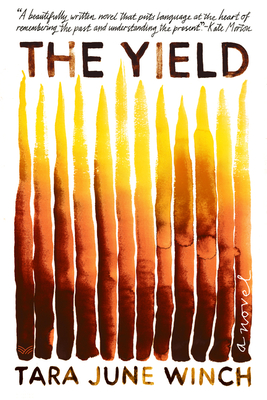
Title: The Yield
Author: Tara June Winch
Type: Fiction
Pages:352
Published: 2019
August Gondiwindi flies back to Australia, rents a car and drives seven hours inland to the aptly named town of Massacre Plains. This is the small town where August grew up in the care of her grandparents. It’s a place “where the sun slap[s] the earth with an open palm.”
It’s the place she fled as a teenager after the traumatic disappearance of her older sister and protector. She is returning after many years for the funeral of her grandfather, Albert “Poppy” Gondiwindi, a revered Wiradjuri (indigenous Australian) elder. She soon discovers that her grandmother and family members are being evicted from their lands because an extraction company has acquired the mineral rights and plans to excavate a vast open-pit tin mine.
The book is a remarkable blend of history, family, politics, and fierce loyalty and devotion. There is a map in the front and a dictionary in the back, although I can’t find some of the words in it that Poppy uses throughout the book. I’m sure I heard the author say something about that, but I don’t remember where! There is, however, a good author’s note with more information.
This reads like a mystery as Augustus comes to terms with returning home and I was turning pages to see what had happened in her past to make her leave.
Winch uses August for the current timeline, sharing some of her memories. She uses Albert to introduce words and to reminisce about his childhood, relate the cultural history he’s learned, and talk about his time-travel. He says he sees spirit people and moves through time and space. He has been writing his dictionary, and each word he introduces is followed by a story and a memory, like the one at the beginning here.
There is power in this story – the legacy we leave, the attitude we have. In the face of losing Prosperous, August’s grandmother says, “Please don’t be a victim, Augie. It’s an easy road, that one.” And this is the message that has lingered – how do situations change if we consider being the victim as the ‘easy path’? I’ve been testing the idea in various scenarios. I haven’t made my mind up as to how far it applies but it’s interesting, and I keep mulling it over, and ultimately, that’s the stuff of a great book
The language, the meanings, the stories is all stuff we should have heard about as young kids at school. It’s shouldn’t be new. But it is & it is so interesting to learn about it all.

 Ocean of Thoughts